
The Girl Who Bound the Fog
Read the first chapters
The prologue and the first two chapters of The Girl Who Bound the Fog, free, with the illustrations from the book. About 20 minutes of reading, or a good bedtime story in three evenings.
In this sample
Prologue
The Night the Moon Broke
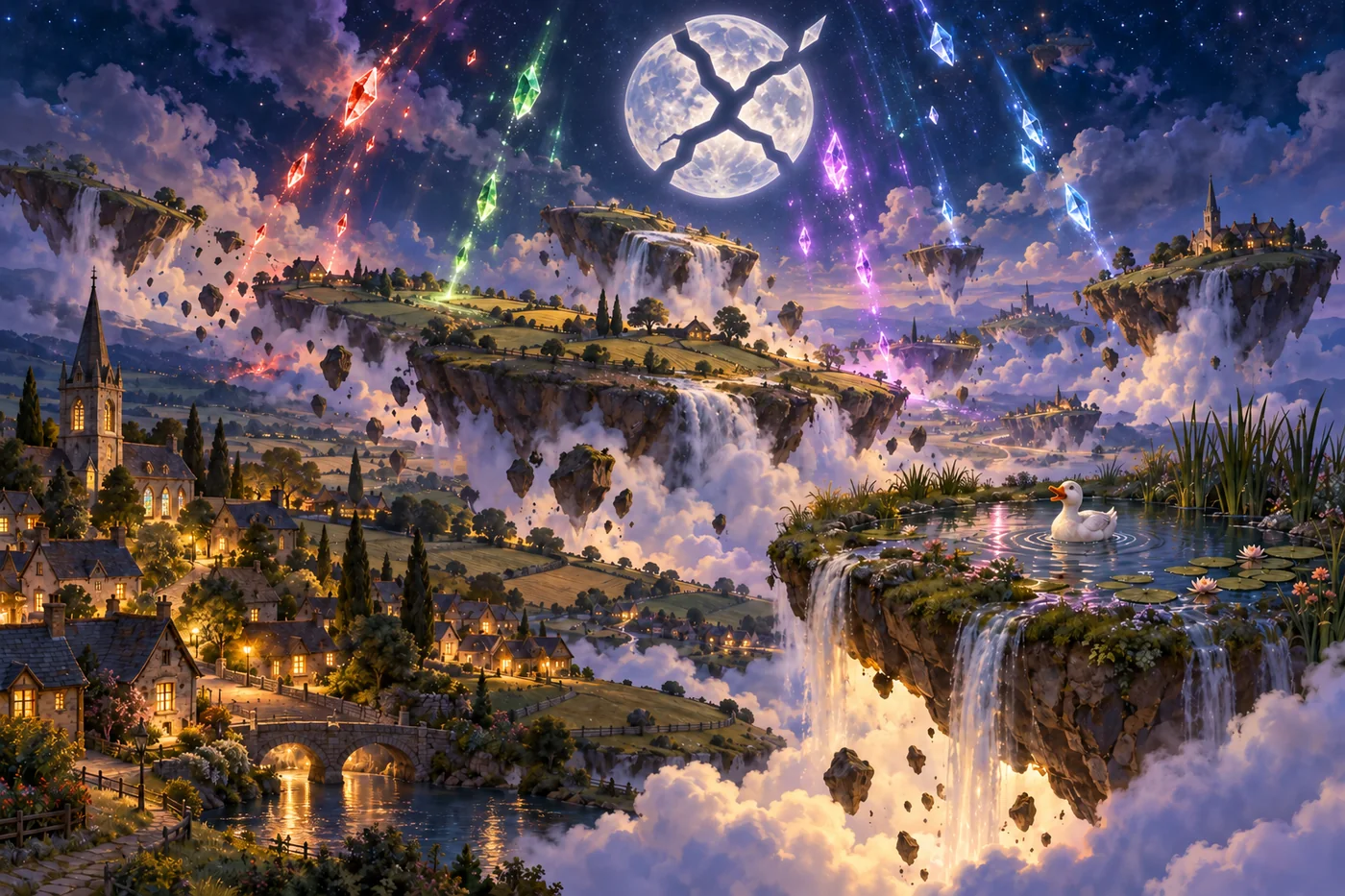
Every child on the Shard Isles knows this story, because every grandmother tells it, and no two grandmothers tell it the same way.
This is how Gran Wren told it, on Lantern Rock, with the wind trying the shutters and the stew going cold because nobody wanted to interrupt.
“Once,” Gran said, “the world was all one piece. You could walk from one end of it to the other and never fall off anything. Imagine that. People were so bored they invented taxes.”
Isla, who was six, did not know what taxes were, but she laughed because Gran had paused for it.
“And the moon was one piece too. Round as a plate. It came up every night and went down every morning and nobody thought about it at all, which is how you treat a thing right up until it breaks.”
“Then it broke,” said Isla.
“Don’t hurry me. Then one night, at the end of an ordinary autumn, somebody looked up and said, ‘That’s odd. There’s a line on the moon.’ And there was. A thin bright line, right across the middle, like a crack in an egg.”
Gran held up one of the eggs from the basket to show her. Isla watched it carefully.
“Nobody heard a sound. That’s the part people forget. It was so far away that it made no noise at all. The line got wider. Then there were two lines. Then the moon broke along them, slowly, like a biscuit in tea: four great pieces, one small one, and splinters beyond counting.”
“And fell down.”
“And fell down. For forty nights. The Long Fall. Little ones first, like sparks off a fire. Then big ones. They came down red and green and silver-blue and a sort of purple, depending. And here is the strange part, the part that made the world you live in.” Gran leaned forward. “They didn’t land like stones. Stones hit the ground and stop. These hit the ground and the ground went up.”
She lifted her hands, slowly, palms flat.
“Whole fields. Whole hills. A village with its church and its duck pond and a very surprised duck. Up they went, as gently as bread rising, and they stayed there. And underneath, where the world used to be, the clouds moved in and never left.”
“The Drop,” Isla whispered.
“The Drop. So now you can’t walk from one end of the world to the other. You need a skiff, and a strong stomach, and money for the skipper.”
Isla thought about this. “What happened to the duck?”
“The duck was fine. Ducks always are. Now. Where the shards landed, something else happened too. A shard that fell into a volcano didn’t melt. It woke up, and what climbed out had a tail made of fire. A shard that fell into a forest grew legs and antlers. One fell into the mountains and came out with a horn and a bad temper. And the ones that fell out here, on the rim, into the fog...”
“Owls,” said Isla. It was her favourite part.
“Owls, and moths, and other small clever things that are gone the moment you look straight at them. Shardlings, all of them. People were afraid at first. People usually are. Then a girl with a herd of goats shared her bread with one, and that was the end of being afraid and the start of everything else.”
“Have you ever seen one, Gran? A real one? Close?”
There was a small silence. Gran got up and put the egg back in the basket, very carefully, as if it mattered where.
“Eat your stew,” she said. “It’s getting cold.”
Above the roof, in a sky with no clouds in it for once, the broken moon hung in its four great pieces, its one small piece and its countless splinters. One of the splinters caught the light and seemed, for a moment, to move.
It would be eight more years before it came down.
Chapter 1
The Last Island
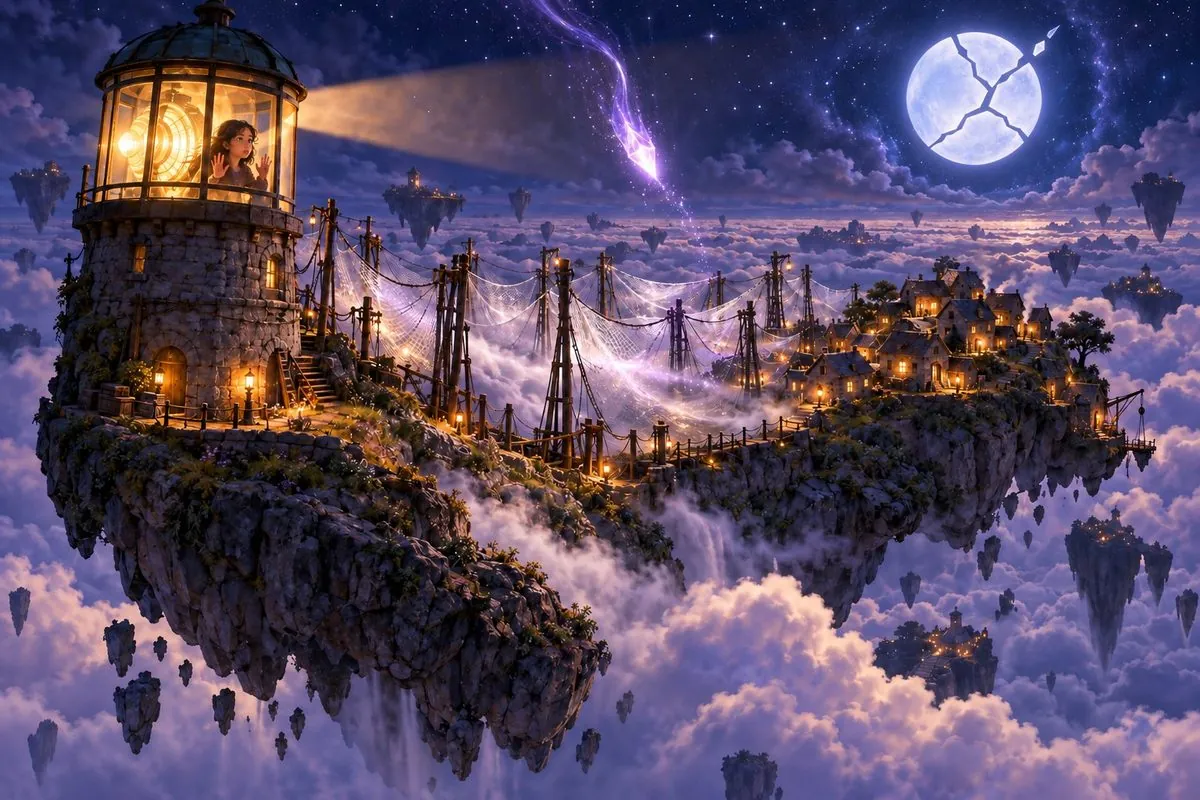
Lantern Rock was the last island before the edge of the map, and it looked like it knew.
It was a quarter of a mile long and shaped like a boot. At the toe stood the light tower. At the heel stood eleven houses, a goat shed and a jetty. In between ran the nets: forty tall frames of knotted cord strung across the wind, which caught the fog as it blew through and dripped it, slowly, into barrels. Nobody on Lantern Rock had ever seen a river. Water was something you combed out of the air.
Isla Wren was up the ninth frame with a mending needle in her teeth when the horn sounded.
“Skiff!” somebody shouted from the heel. “Skiff from the south!”
She said a word around the needle that Gran would not have liked, tied off the knot she was on, and looked. A square brown sail was coming up out of the haze, low and fat. That was the Marigold, the supply skiff, which came every nineteen days if the weather let it. It was not due for another week.
“Early,” Isla told the net. “It’s never early. Something’s happened.” She talked to the nets a good deal. They were better listeners than most of the eleven houses.
She was fourteen, nearly fifteen, small for it, with dark hair that the wind had given up on years ago and a way of looking at things slightly from the side, as if they might do something when they thought she had stopped watching. She owned one coat. It had been Gran’s, and before that it had belonged to somebody whose name Gran did not mention, and it had a patch on the left shoulder in the shape of a small bird.
She slid down the frame, landed in the wet grass and ran.
By the time she reached the jetty, most of Lantern Rock was already there, which is to say twenty-three people and a goat. The Marigold bumped against the posts. Skipper Tamsin threw a rope, and a boy Isla had never seen caught it at the wrong end and nearly went into the Drop.
“Other end, Bo!” roared the skipper.
“I know!” said the boy, who clearly had not known. He was about her age, broad and cheerful, with a face that looked as if it had been interrupted in the middle of a joke. He tied the rope off in a knot that made three net-menders wince, and beamed at the island in general.
But nobody was looking at him for long, because a second person was climbing out of the skiff.
She was a tall woman of about sixty in a grey coat with silver buttons. She carried a long brass horn under one arm and a leather case under the other, and she stepped onto the jetty like someone who had stepped onto a great many jetties and thought no better of this one. On her collar was a small pin: a circle, cracked across the middle.
“League caller,” old Per breathed, next to Isla. “Haven’t had one out here in thirty years.”
The woman waited until the whispering had stopped. She did not seem to mind how long it took.
“Good afternoon,” she said. “My name is Odalys Quill. I am the referee of the Concord of Binders for the Veil Isles, and I am required by the rules of the Concord to announce the season on every inhabited island in my district. This is the last one. I have been travelling for eleven days and I would like to be brief.”
She lifted the horn and blew one long flat note that sent the goat under the jetty.
“The Isle League of the Veil Isles opens at Greywater on the first day of the thaw. Any person of twelve years or over who holds a registered bindstone, and whose Shardling answers them, may enter. The top two go on to the Reaches. The best of the Reaches go on to the Moonfall Crown.” She lowered the horn. “Entry is four silver. Are there any binders on this island?”
There was a long pause, filled mostly by the wind.
“We’ve got a goat,” said old Per.
Some people laughed. Odalys Quill did not, but something happened at one corner of her mouth.
“Then I thank you for your attention,” she said, “and I would be grateful for a cup of something hot.”
Isla was not laughing either. She was looking at the leather case. One of its buckles had come undone on the crossing, and through the gap she could see a row of flat grey stones, each in its own little pocket, each with a faint light inside it like a coal seen through fog.
Bindstones. Real ones.
She had not known, until that second, how badly she wanted something.
“Four silver to enter,” she said that evening, stabbing a potato. “And eighty for a stone, the boy said. Bo. The skipper’s son. He said you have to buy them from an academy, and the nearest academy is nine days south, and they only sell to people who’ve done the course, and the course is two hundred. Two hundred, Gran! We don’t have two hundred of anything. We don’t have two hundred potatoes.”
“We have about a hundred and sixty potatoes,” said Gran, who was mending a lamp wick and had not looked up. “I counted on Tuesday.”
“That’s not the point.”
“What is the point?”
Isla opened her mouth and found that she did not have it ready. The kitchen at the foot of the light tower was small and warm and smelled of lamp oil. Above them the great lantern turned on its gears with a sound like slow breathing. She had fallen asleep to that sound every night of her life.
“The point,” she said at last, “is that I’m going to mend nets until I’m as old as Per, and then I’m going to tell people about the goat.”
Gran put the wick down.
Maren Wren was a narrow, upright woman with white hair cut short and hands that were never still. She had kept the Lantern Rock light for twenty-six years. Before that she had been somewhere else, doing something else, and the whole island had long ago stopped asking.
“There’s nothing wrong with nets,” she said. “Nets are honest. A net never promised anybody anything.”
“Did somebody promise you something?”
Gran’s hands stopped moving, which was so rare that Isla noticed it the way you notice a clock that has stopped.
“Finish your potato,” Gran said. “The glass is dropping. There’ll be weather tonight, and I want the shutters done before it comes.”
The weather came at midnight, and it was not weather.
Isla woke because the room was the wrong colour. Her window faced north, toward the open Drop, where there was never anything to see. Now the whole square of it was glowing a soft, steady violet, the colour of the inside of a shell.
She was at the glass before she was properly awake.
Something was coming down the sky. It was not fast. It fell the way a feather falls, in a long slow curve, trailing a thread of light behind it. It was no bigger than a lantern. As it dropped below the level of the tower, it lit the fog from inside, and for a moment Isla could see every strand of every net on the island drawn in silver.
A skyfall. She had heard them described all her life. She had never thought one would have the manners to fall where she could watch.
“Violet,” she whispered. “Violet is Mist. Red is Ember, green is Root, silver-blue is Iron, and violet...”
The light sank toward the middle of the island. It touched the top of a net frame. There was no crash. There was a sound like a single note on a glass, very high and very clean, and then the violet went out, and the night was the ordinary colour again.
Isla stood with both hands flat against the cold window.
The ninth frame. It had come down in the ninth frame. She had been mending that net all afternoon.
Above her the lantern turned and breathed. From Gran’s room came no sound at all, which meant Gran was either asleep or listening very hard.
Isla found her boots in the dark. She put the coat on over her nightshirt and did up the buttons wrong. Then she opened the door as quietly as a door on Lantern Rock can be opened, which is not very, and went out into the fog.
Chapter 2
The Thief in the Nets
Fog at night on Lantern Rock was not something you walked through. It was something you remembered your way through.
Isla counted frames by touch. One, with the split post. Two. Three, where the barrel leaked. The cords hummed in the wind on either side of her like the strings of something enormous. Her nightshirt was wet to the knee in the first twenty steps.
“This is stupid,” she informed the fog. “It’s a rock. It’ll still be a rock in the morning. I could be in bed.”
The fog had no opinion.
“Although if it’s a rock in the morning, then Per finds it. And Per sells it to the skipper for a jar of pickles. So really, going now is the sensible thing.” She felt better for having worked that out. Seven. Eight.
At the ninth frame she stopped.
There was a hole in her net. All of that afternoon’s mending and a good piece of last week’s had been torn straight through, and the loose ends were swinging. Tangled in the cords about a foot above her head, wrapped up like a fly in a web, hung a stone the size of her fist.
It was not grey like the ones in the referee’s case. It was the colour of the sky an hour after sunset, and it was lit from the inside. The light came and went, slowly. In and out.
“Oh,” said Isla.
She climbed. The frame was slick, and she did it one-handed because the other hand had her mending knife in it. She cut one cord, then another, and the stone dropped into her palm.
It was warm. Not hot, but warm like a bread roll that has been in a pocket. And the moment it touched her skin, the light inside it gave a sort of jump, the way a sleeper jumps when you say their name.
“Hello,” Isla said, feeling ridiculous. “I’m Isla. You’ve wrecked my net.”
The stone cracked.
She very nearly dropped it. A thin bright line ran across it from end to end, exactly like the line in Gran’s story, and then the whole thing opened along the line like a seed. Something unfolded out of it. It did this in a great hurry and in the wrong order: a wing, then a foot, then a second wing that hit her in the ear, then a round head with two tufts on top.
Then it fell off her hand, because there was suddenly a great deal more of it than there had been of the stone, and landed in the wet grass at the bottom of the frame with a noise like a dropped cushion.
Isla climbed down very slowly.
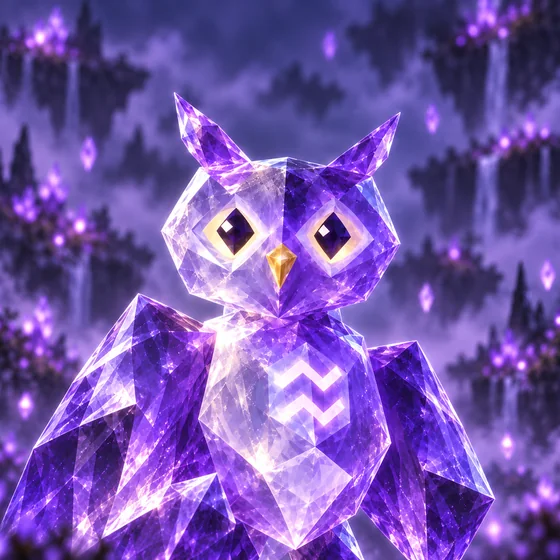
It was an owl, more or less. It came up to her knee. It looked as if somebody had built it out of nine or ten large pieces of violet glass and had been called away before they could smooth the corners. Its chest was pale and its wings were dark, and in the middle of its chest two small wavy lines glowed, one above the other, like a drawing of water.
It had enormous eyes. They were the colour of lamplight, and they were looking at her coat.
Specifically, they were looking at her left pocket.
“What?” said Isla.
The owl took two steps forward. It walked like a small, important man in boots that were too big for him. It stretched up, put its whole head into her pocket and came out again with half a cheese sandwich, which Isla had put there at noon and forgotten.
“That’s mine!”
The owl looked at her. It looked at the sandwich. It swallowed the sandwich in a single movement, paper and all, without taking its eyes off her face.
Then it made a noise.
Isla had always supposed that Shardlings would sound grand. This one sounded like a kettle that had been stepped on. It was a long, rising, indignant squeal, and it went on for some time, and when it was finished the owl sat down hard in the grass and looked at its own feet with great surprise, as though it had only just been issued them.
“Shh!” Isla hissed. “You’ll wake the whole island! Hush!”
The owl squealed again, louder.
“Hush! Hush, hush, hush...”
It stopped. It tilted its head almost upside down. The two tufts went up.
“...Hush?” said Isla.
The owl got up, marched over and leaned against her shin, quite heavily, the way a cat does when it has decided that you belong to it.
“That’s not your name,” Isla told it. “I was telling you to be quiet. It’s the opposite of a name. It’s an instruction.”
The owl closed its eyes.
“Fine,” she said. “Hush. But it’s ironic. I want you to know that.”
She found the two halves of the stone in the grass. They were cold now and nearly dark, and when she pressed them together they closed with a small click and left no seam she could find. Only the faintest glow was left, deep in the middle, like the last coal in a stove.
She knew what it was. Everyone knew, the way everyone knows what a crown is without ever having held one.
“This is a bindstone,” she said slowly. “You came out of this. So if I’ve got it, and you come when I call, then I’m a...”
She could not say the word. It was too big to get out past her teeth.
She tried something else. She held the stone out in her flat hand, the way Bo had described it on the jetty with his mouth full, and said, “All right. Go back in.”
Hush opened one eye, looked at the stone, and looked away again with a great show of not having heard.
“Rest. Go to stone. That’s what they say. Go on.”
Hush walked off into the fog.
“No! Not away! In!” She went after him and found him four frames down, standing under a barrel with his beak open, catching the drips. He seemed to think this was the best thing that had ever been invented.
It took the rest of the night. She tried ordering. She tried asking nicely. She tried pretending not to care, which had worked on the goat once. Some time before dawn she sat down against a net post, soaked through and shaking with cold, and said to nobody, “I don’t know how to do this. I don’t know how to do any of it. I mend nets.”
There was a rustle. Something heavy and warm and slightly sharp at the corners climbed into her lap, turned round twice and settled.
The stone in her hand grew warm again. The light in it rose, and at the same moment the weight in her lap grew less, and less, like a thing remembered. Then her lap was empty, and the stone was glowing the colour of the sky an hour after sunset, slowly, in and out.
Isla sat very still.
“Oh,” she said. “You weren’t refusing. You just weren’t tired yet.”
It was the first thing she ever learned about binding, and it was years before she understood that it was also the most important. You cannot put a friend away because it suits you. You can only be somewhere they are glad to rest.
She got home as the sky was turning grey. She took her boots off outside. She opened the door as quietly as a door on Lantern Rock can be opened.
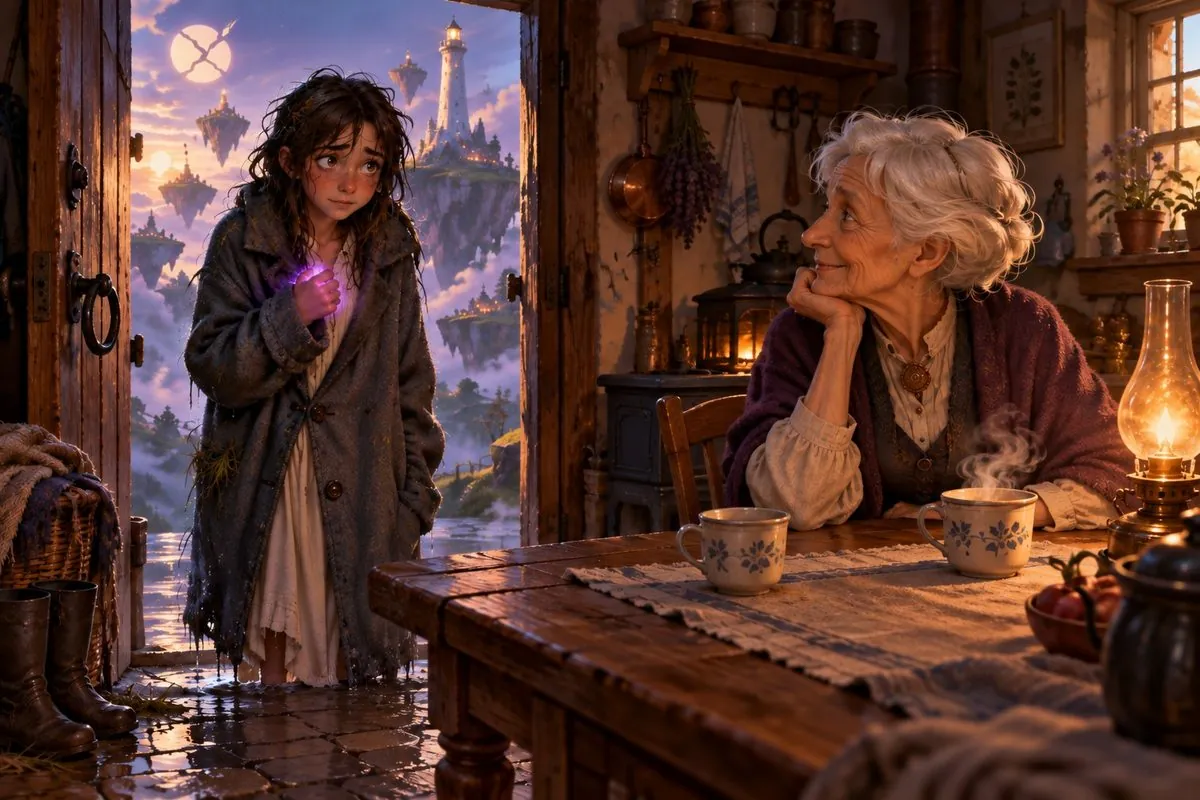
Gran was sitting at the kitchen table, fully dressed, with two cups of tea in front of her. One was half drunk. The other was still steaming.
Isla stood on the mat and dripped.
Gran looked at the wrong-buttoned coat and the grass in her hair. Then she looked, for a long moment, at Isla’s closed right hand, and at the violet light that was coming out between the fingers.
Something crossed her face that Isla had never seen there before. It was not anger. It looked more like somebody hearing a tune they had not heard in forty years.
“Well,” said Gran. “Sit down before you fall down. And tell me what it ate. They always eat something first, and it tells you a good deal about them.”
“A cheese sandwich,” Isla said. “And the paper.”
Gran closed her eyes.
“A Mist one,” she said. “Naturally. It would be.”
How does it go on?
Isla has a Shardling now, and Hush has eaten a cheese sandwich. In the rest of the book they cross the four bridges, travel the Shard Isles and find out what a wild bond can do. The whole novel is out on Amazon:
Free to read with Kindle Unlimited. Also in German: Das Mädchen, das den Nebel band (amazon.de).
A gift for Christmas
The paperback is an illustrated adventure for readers from eight to eighty: for children who love animal companions, and for grown-ups who like to read aloud.
Hush in the card game
Hush is a Veilowl, and the Veilowl is a Mist card in Shardmoon, the free card game set in the same world. Meet the Shardlings of the book, or play it right in your browser, no download needed.